Showing posts with label play readings. Show all posts

Wednesday, January 31, 2018

An MFA program that works

I've recently returned from our low-residency MFA in Writing for Stage and Screen program's January residency in Peterborough, NH.  As Program Director I'm happy to say that again it was a big success. 

By "success" I mean that all of our student writers were once again immersed fully in this retreat-like setting, attending classes, workshops, special talks by Visiting Artists, and, most importantly, were able to share a new full-length script they wrote during the previous semester with their fellow students, our faculty of established writers, and the many actors and other industry professionals that join us for our ten-day bi-annual intensive.
 
As I've said before on this blog, I think the biggest draw for our two-year program is that before graduation, all our student writers will have written at least four full-length scripts.  And they walk away with a strong beginning body of work under their arm, work that's been given initial testing with professional actors in table readings and/or staged public concert readings.  It's this feature that makes our program unique nationally and its success is most accurately evidenced by the serious and growing recognition that our student and alumni scripts are receiving in the marketplace.

I urge any readers of this blog who are considering looking into MFA playwriting or screenwriting programs to take a look at ours.  It is designed for serious writers who are intent on building a solid foundation on which to launch a successful writing career in our industry.


Oh, and thanks to current student and photographer Kara Krantz for the photos.

                                              *                    *                   *                   *

I'm the Program Director of the low-residency MFA in Writing for Stage and Screen being offered by the New Hampshire Institute of Art.  Our last residency ran from January 5 to 14 and we're currently  considering applications for starting the program at our June 2018 residency that runs from June 22 to July 1.  The application deadline for a June start is May 1.  If you're interested in finding out more about our program, email me at buzzmclaughlin@gmail.com and we can start a dialogue.

I'm also a playwright and screenwriter, producing partner in my production company Either/Or Films (The Sensation of Sight and Only Daughter) a professional script consultant, and the author of The Playwright's Process.  You can follow me on Twitter @eitherorfilms or @mfastagescreen.  I’m also on Facebook at buzzmclaughlinscriptconsulting.   

Wednesday, January 4, 2017

Our bi-annual gathering of scriptwriters...

It's that time again.  Every January and June, there is this special gathering of playwrights and screenwriters in the quaint mountain village of Peterborough, NH for a ten-day marathon of sharing new work and participating in intensive workshops on our craft and our industry.  Our next get together launches this Friday, January 6.

Of course what I'm talking about is our low-residency MFA in Writing for Stage and Screen offered by the New Hampshire Institute of Art.  Talented student writers from all over the country--from New Mexico to Florida, from Texas to Michigan and from New York City to Dallas--as well as San Juan, Puerto Rico and Wabasca, Canada will all gather together to celebrate our art form with a distinquished professional faculty drawn from various aspects of our profession.


There will be intensive pitch sessions of new story ideas, craft classes in dialogue and rewriting and career oriented workshops on submission tactics and the national new play development arena. And central to the residency will be ten readings of new work written by our students this past semester, all of which are cast with professional actors and are followed by extensive feedback sessions.

To top off this residency, we've invited our alumni back for the opening weekend to share their adventures in the scriptwriting trade and to help further expand our growing networking apparatus on a national level.

Overall, these residencies are a time and place for emerging writers to share their passion for their art and expand their skill and their horizons as artists.  And all student writers leave the experience renewed and ready to go to work during the semester on their next project with their assigned professional mentor--developing a new script they'll share with the whole group at the next residency.

It's quite special.  Come join us if you can.

                                  *                    *                   *                   *

I'm the Program Director of the low-residency MFA in Writing for Stage and Screen being offered by the New Hampshire Institute of Art.  Our last residency ran July 21-31, 2016 and we are about to start our next residency that runs January 6-15.  We are currently accepting applications for starting the program with our June residency running from June 22-July 2.  I'm also a playwright and screenwriter, producing partner in my production company Either/Or Films (The Sensation of Sight and Only Daughter) a professional script consultant, and the author of The Playwright's Process.

Tuesday, August 16, 2016

Welcome to the script factory...

Last month in Peterborough, New Hampshire there was a ten-day explosion of creative storytelling as 13 full-length scripts--plays, screenplays,and tv pilots--were lifted off the page for the first time.

Writers from all over the US and Canada gathered in this culturally alive village in the heart of New England to celebrate their art with professional actors, directors, designers, producers, and public audiences--everyone involved and focused on the new work being presented.  It was a high energy and exhilarating time for all participants and everyone left the gathering recharged and recommitted to our shared collaborative art form and the scripts that ignite it all.


What I'm referring to, of course, is the latest residency experience of the low-residency MFA in Writing for Stage and Screen program run out of the New Hampshire Institute of Art.  The program boasts a faculty of established professional writers and other visiting theatre and film professionals who teach classes and workshops and who mentor our students throughout the two-year course of study.  And at the heart of the program are the new scripts being written by every student--at least four full-length works while in the program--all of which are read and critiqued at each of the five residencies the students participate in.

Our program is nationally unique in its commitment to having every student create a substantial beginning body of work that serves as a launching pad for his or her script writing career.  Every effort is made to refine the craft and skill of our student writers and to realistically prepare them for the rigors of entering the professional writer's arena in the various mediums.  This is our trademark and our promise to every student, and our growing list of alumni and their successes lends credence to that commitment.


If you're looking for a place to learn and grow as a script writer in a safe and supportive, yet challenging environment, I suggest you check out our program.  The added bonus is that when you complete the program, you not only are prepared to begin your professional writing career, but you also walk away with that terminal degree under your arm.

                                  *                    *                   *                   *

I'm the Program Director of the low-residency MFA in Writing for Stage and Screen being offered by the New Hampshire Institute of Art.  Our last residency ran July 21-31, 2016 and we are now considering applications for starting the program with our January 2017 residency that runs January 6-15.  I'm also a playwright and screenwriter, producing partner in my production company Either/Or Films (The Sensation of Sight and Only Daughter) a professional script consultant, and the author of The Playwright's Process.

Tuesday, May 10, 2016

MFA scriptwriting program spreading its wings...

A few weeks back--March 28 to be exact--a group of theatre artists who are a part of our MFA program in Writing for Stage and Screen staged a reading at the historic Players Club in NYC.  The script was To Moscow by our faculty member Karen Sunde.  The director was Robert Lawson, also on our faculty.  The producer was Steve Ashworth from Edmonton, Canada, a recent graduate of our program.  And two of the lead actors, Lisa Bostnar and Gordan Clapp, are members of our program's acting ensemble.  To top it off, a large group of current students, faculty, and alums were in the packed audience and were a part of the talk-back session following the reading.


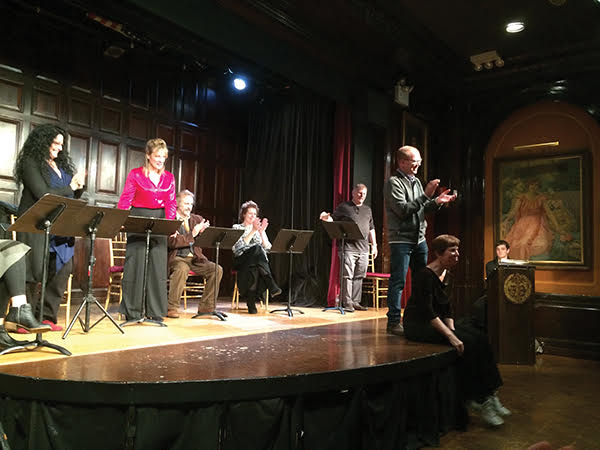
That's playwright Karen Sunde sitting on the stage, producer Steve Ashworth standing next to her, Gordon Clapp behind Steve, and Lisa Bostnar (in pink) with the other actors.

And here is the write up of the reading in the Greenwich Village paper Westview News.

I mention this event because it's a great example of what goes on with a writer's work once it starts to hit the development arena.  The hopes are that this project will experience a bigger life with this collected ensemble of artists.  And it also is a testament to our MFA program and our commitment to helping all of our writers get their work launched into the world and brought to life on the boards. For as we find ourselves constantly explaining, a script is a means to an end and not an end in itself.

                                    *                    *                   *                   *

I'm the Program Director of the low-residency MFA in Writing for Stage and Screen being offered by the New Hampshire Institute of Art.  Our last residency ran January 3-11, 2016 and we are now considering applications for starting the program with our July 2016 residency that runs July 21-31.  I'm also a playwright and screenwriter, producing partner in my production company Either/Or Films (The Sensation of Sight and Only Daughter), a professional script consultant, and the author of The Playwrights Process.
 

Tuesday, June 2, 2015

Preparing for a script reading marathon

I'm currently in the midst of casting and scheduling twelve full-length script readings as part of the low-residency MFA in Writing for Stage and Screen that I run out of the New Hampshire Institute of Art.

A major feature of the program is to offer our student writers the opportunity to experience their scripts (both plays and screenplays) come alive and given voice for the first time by professional actors--an initial test of their new material written during the semester just ended--and to get valuable feedback from faculty (all professional writers), fellow students, the actors participating, as well as other invited professionals. We are committed to this aspect of our program because it's the only true way for writers to learn what works and what doesn't and to become a part of the collaborative process that our industry embraces.

But pulling all this off is not an easy task.  Our residency is ten days long and two of these days are taken up with other aspects of the learning process--Visiting Artist talks, special elective courses, and talks by graduating students.  And in the eight days remaining, the readings have to be fitted in between intensive classroom work where various elements of the craft and business of script writing are explored in-depth.  Not to mention having to work around actor schedules.

So "marathon" is a pretty accurate word to describe this cornucopia of new work being released for the first time, all of which takes place in various conducive venues in our beautiful Peterborough, NH homebase.  Our residencies have become a glorified script writers' camp where students and other artists from all over the country and Canada gather to celebrate and study our art.  Crazy as it gets at times, it's where our students learn how to be successful storytellers in a field that turns their stories into living performances bound for the world's stages and screens.

We may all leave the residency staggering home from sheer exhaustion (coupled with a large dose of inspiration), but we wouldn't have it any other way.

                                   *                    *                   *                   *

I'm the Program Director of the low-residency MFA in Writing for Stage and Screen being offered by the New Hampshire Institute of Art.  Our next residency runs June 19-28 2015.  We are now considering applications for starting the program in January 2016.  I'm also a playwright and screenwriter, producing partner in my production company Either/Or Films (The Sensation of Sight and Only Daughter), and a professional script consultant.

Friday, March 22, 2013

The Initial Test of Your New Script

One of the things I've observed in my career as a writer of plays and screenplays and as a producer of new scripts is the critical importance of that very first test of new material with other artist/collaborators.  In other words, there's a lot at stake when your new script is being given voice for the first time.  This phase in the life of a new screenplay or play is--for you, the writer--often a make or break moment.

When I founded the Playwrights Theatre of New Jersey many years ago, my primary motivation was to help writers with this delicate first "release" of their new script to the wider world.  I knew that the actors assembled to give the work its first read had to be carefully chosen for each role and had to be very good at bringing words on the page to life with little or no rehearsal.  I knew that to do otherwise would risk the writer concluding that they'd lost their hearing, as playwright Wendy Wasserstein told me when she described her response to a first reading of a new play of hers.  Some of the actors were simply not right for the roles and she had trouble recognizing the play she'd just finished writing.

Or as playwright and Academy Award-winning screenwriter John Patrick Shanley told me when he first released his wonderful play Danny and the Deep Blue Sea:  "I thought [it] was a dead loss on the basis of a reading.  I heard the reading and I said, 'Well, I guess I was wrong.  I thought it was good.'  Then I did another reading and I thought, 'Well, it's better.'  And then I got some good people and I thought, 'All right, now we're talking!'  So you have to be very careful not to write off a [script] on the basis of a bad reading."

Just realize that your initial launch with new material--allowing other artists to connect with it for the first time--is more significant than you may at first realize.  As eager as you may be to hear your script come to life for the first time, be careful to gather actors that are talented, are a good match for the character they're reading, and know what their character's function is in the play or screenplay.